Lead Client / Foundations Engineer (Unity, C#/.NET, C++)

Hello, my name is Vincent J. Liguori. I build client foundations: scalable Unity architecture, tooling, UI systems, and performance work that helps teams ship and keep shipping. I’ve owned end-to-end frameworks (Windows + WebGL/mobile browsers), built content pipelines (Addressables + cloud hosting), and developed real-time simulation tooling in C++/DirectX.

I’m most useful when the problem is “hard and cross-cutting”: memory/GC stability, asset lifetime, load/unload correctness, UI scalability, and the engineering standards that keep a codebase healthy as content grows.

Game Architecture and Design Patterns:

  • Modular and reusable architecture
  • Dynamic game generation
  • State management using events
  • Implementation of robust systems for scalability

User Interface (UI) Development:

  • Experience with Unity's legacy Canvas system
  • Experience with Unity's new UI Toolkit
  • Dynamic UI generation and customization
  • Responsive design for different screen sizes

Asset Management:

  • Utilization of Unity's Addressables system
  • Dynamic loading and unloading of assets
  • Efficient use of resources and optimization

Animation and Visual Effects:

  • Integration of Spine animations
  • 2D animation walk cycles
  • Immersive visual effects and transitions

Localization and Serialization:

  • Implementation of Localization API for string and sprite localization
  • Serialization and deserialization of JSON data

Audio Management:

  • Utilization of Unity's audio mixer system
  • Managing game music and sounds with separate audio streams

Performance Optimization:

  • Performance analysis and optimization techniques
  • Multithreading and efficient use of resources
  • Optimization of rendering and asset loading

Tool and Package Creation:

  • Creation of custom tools for development
  • Package management through NPM and private Git URLs

Cloud Hosting and Integration:

  • Setup of Unity project with AWS for cloud-hosted addressables through Amazon S3

Scriptable Objects:

  • Experience in using Scriptable Objects for efficient data management

Best Casino Legends Slot 777

I led client foundations work on a Unity F2P slot framework used to ship Best Casino Legends Slot 777. My work focused on scalability and live iteration: Addressables + cloud-hosted bundles (AWS S3) for on-demand loading, internal packages/tools to standardize setup, and a front-end customization API to configure game variants from a shared foundation. I also implemented localization (strings + sprites), JSON state serialization/deserialization, and audio mixer routing for separate music/SFX streams.

VMAX Simulator

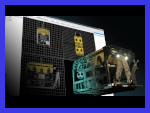
At Forum Energy Technologies, we built a simulation tool for training ROV pilots and validating offshore equipment. I worked on the 3D engine and built tools that automated CAD cleanup by removing hidden/small geometry, reducing manual export/cleanup time.

Space Invaders

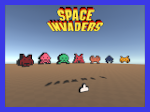
A small WebGL project focused on clean gameplay architecture and responsive input. Includes a playable build on this site and a public codebase for review. Controls: arrows + spacebar.

If you're curious about the behind-the-scenes magic or wish to explore the codebase, please check out the game's GitHub repository.

MLP Pony Up

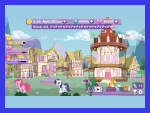
Solo-programmed demo for an idle/clicker-style game. Implemented input, audio, parallax background, and the animation/controller logic.

Star Cluck.

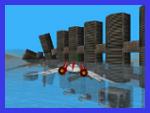
During my graduate studies in 2009, I worked on a project named 'Star Cluck,', a 3D rail shooter game inspired by Star Fox. The game was developed using C++, DirectX 9, Visual Studio, and the Simple Academic Game Engine (SAGE). As part of the project, I made several contributions that helped enhance the overall gameplay experience such as level scripting, infinite terrain with terrain wrapping, spatial partitioning, triggers, and collision detection with oriented bounding boxes. To ensure that the player's plane stayed within the game boundaries, I implemented a flight path that relied on collision with spatial partitions. Finally, I created a camera tether with tolerance to provide a smooth and responsive player experience. Overall, my contributions to the Star Cluck project helped to create an enjoyable and engaging gaming experience for players.

Fury Mallard.

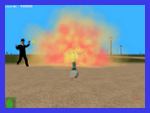
During my undergraduate studies in 2008, I worked on a game demo called 'Fury Mallard', a third-person shooter game. The game was developed using C++, DirectX 9, Visual Studio, and the Simple Academic Game Engine (SAGE). My primary responsibilities included crafting the artificial intelligence for the characters and aircraft, a feature that significantly contributed to the immersive and dynamic nature of the game.